

Transcript:
Our eyes play the role of chief timekeeper for our circadian rhythms.
This is through the help of special types of light-detecting cells in our retina.
For nearly 150 years, scientists have studied visual perception and the influence of ‘rod’ and ‘cone’ cells that enable us to see shape and colour.
In 1998, a groundbreaking discovery revealed cells that process non-visual light information.
These special, non-visual light detectors allow our circadian rhythm to accurately tell the time.
At least, they used to be accurate before the introduction of artificial light.
These cells are called ‘intrinsically photosensitive retinal ganglion cells” or ipRGCs for short.
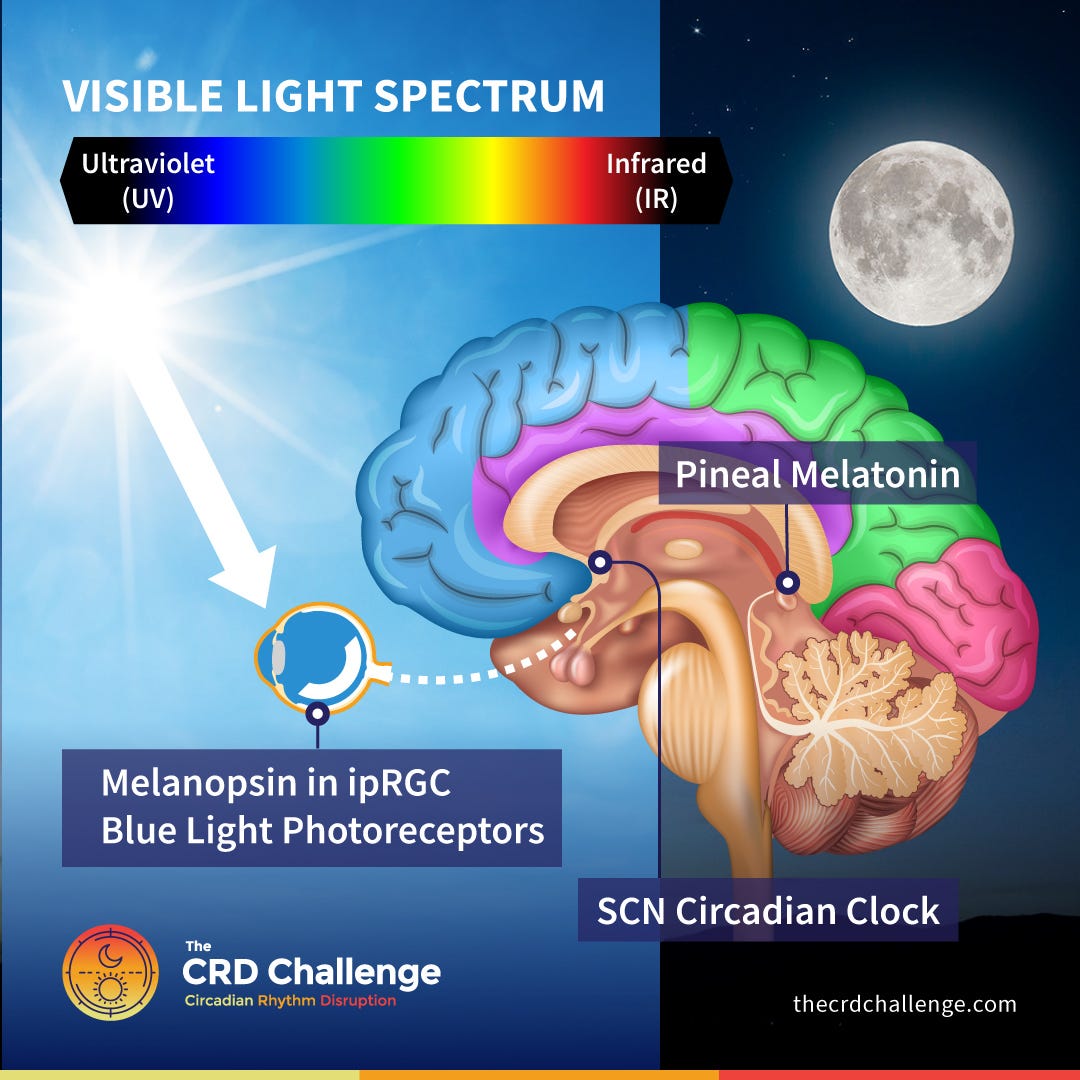
ipRGCs contain a light-sensitive pigment called melanopsin.
Melanopsin, which is also found in our skin, is particularly sensitive to detecting blue light wavelengths.
When melanopsin gets a blue light signal, it sends nerve impulses to the suprachiasmatic nucleus (SCN), the SCN, the master conductor of the circadian orchestra.
This is how information about the time of day travels from the light in our environment into our circadian rhythms.
Think of melanopsin as a translator that takes the incoming light signals from our environment to tune our clocks.
It instructs our body on how it should align the timing of our daily biological processes.
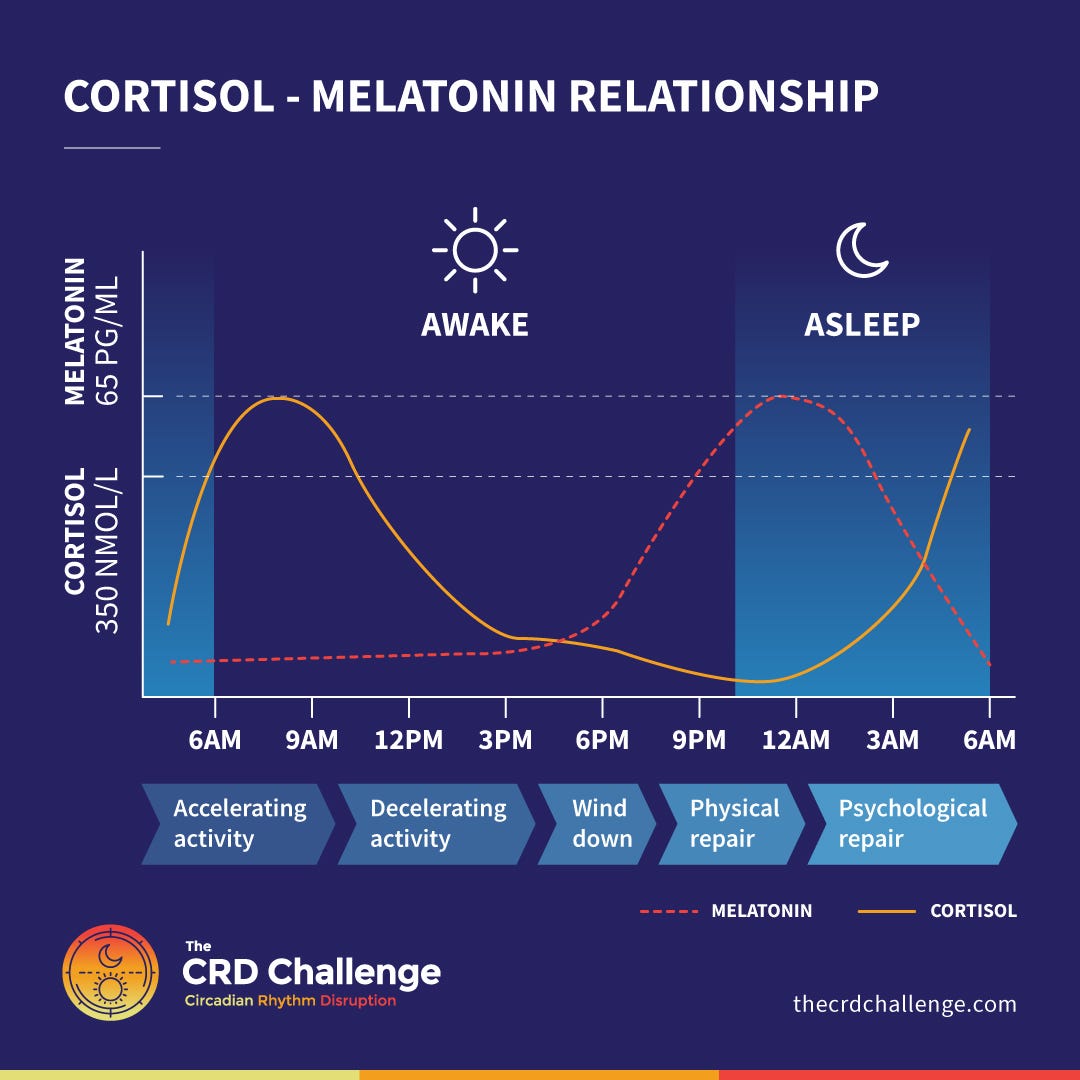
These signals most especially cue the production of our 2 master circadian hormones: cortisol and melatonin.
Blue light from the morning cues cortisol in the earlier part of the day.
And then, as daylight wanes and the blue light disappears, our body will shift to releasing melatonin in the evening.
At least, that’s how it should work.
To better appreciate the significance of this information, you’ll need to understand just a few more characteristics of light.
Then you’ll be able to grasp exactly why different types of light at different times of the day matter to our circadian biology.
Wavelength - The “Colour” of Light
We identify different colours of light by their wavelength, which we measure in nanometers.
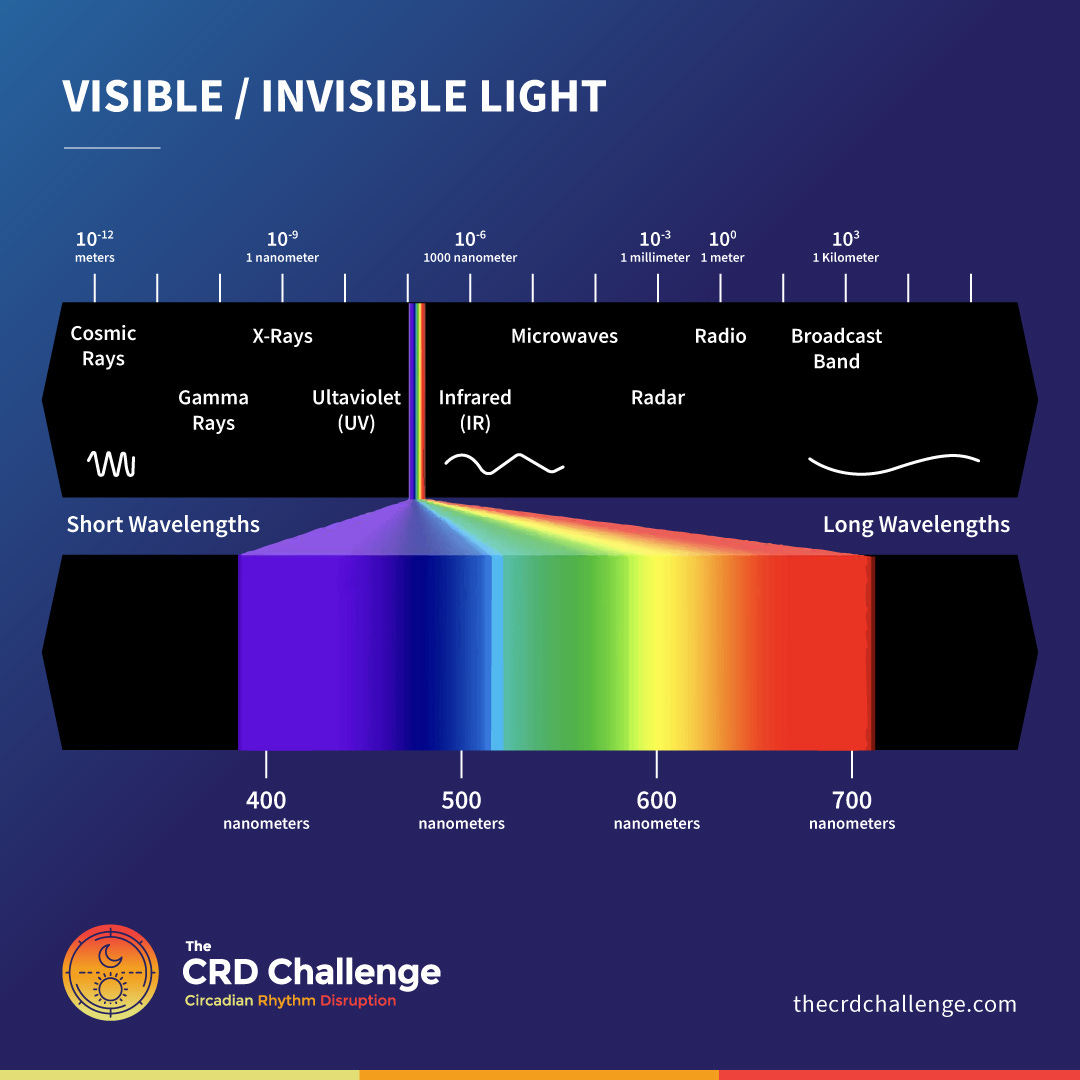
Today, we’re going to learn specifically about UV light, visible light, and infrared light.
These types of light are all emitted by our sun, which is a ‘full spectrum’ light source.
The sun’s invisible UV rays contain the shortest of these spectral wavelengths.
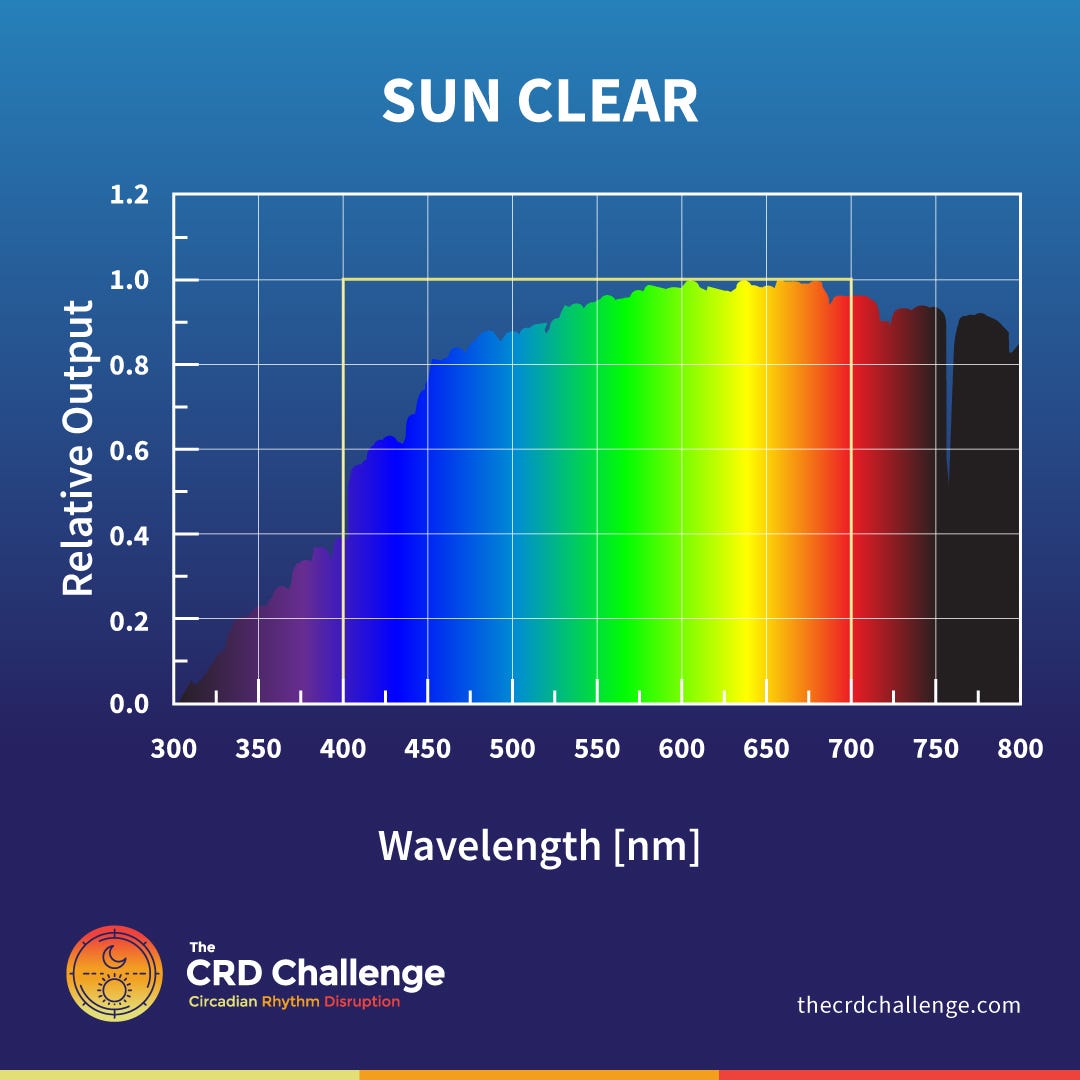
The visible light spectrum contains wavelengths that are longer than UV rays and can be divided into two groups:
Shorter ‘cooler’ wavelengths that are closer to UV light include indigo, violet, blue and green.
Longer ‘warmer’ wavelengths of yellow, orange and red are farther from UV rays.
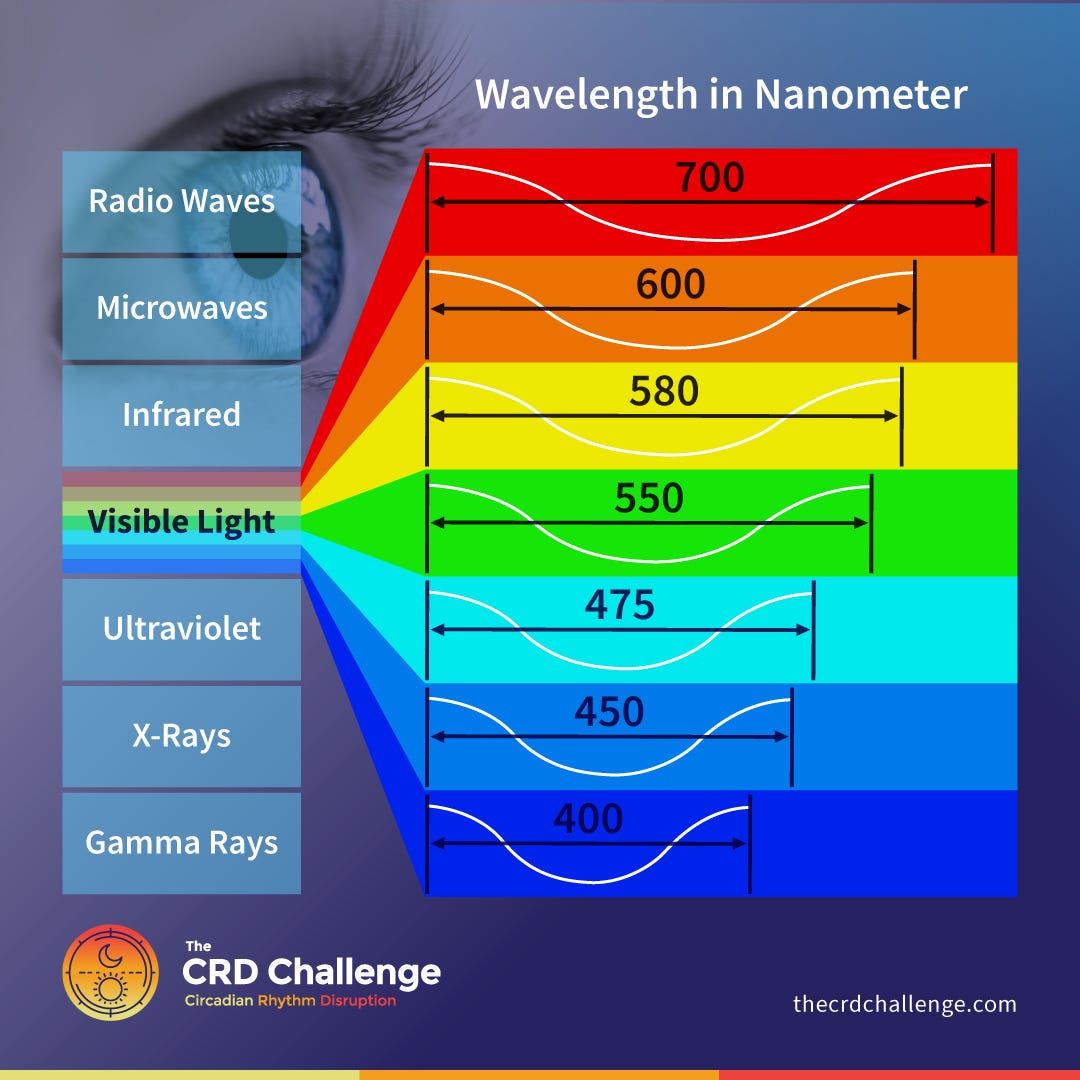
They are closest to the longest and widest wavelength band we’ll talk about today, which is infrared light.
Infrared light is invisible to the human eye because it is out of the spectrum our eyes are tuned to see, similar to UV light which is also outside of our visual detection capabilities.
The light emitted by our sun dynamically shifts through each of these frequencies over the course of the day.
Blue wavelengths appear in smaller amounts around sunrise, steadily increasing until noon.
This means the sun transmits a progressively stronger signal to melanopsin over the course of the morning. The master clock, the SCN in our brain, gathers this light, anchoring the biological message of ‘daytime’.
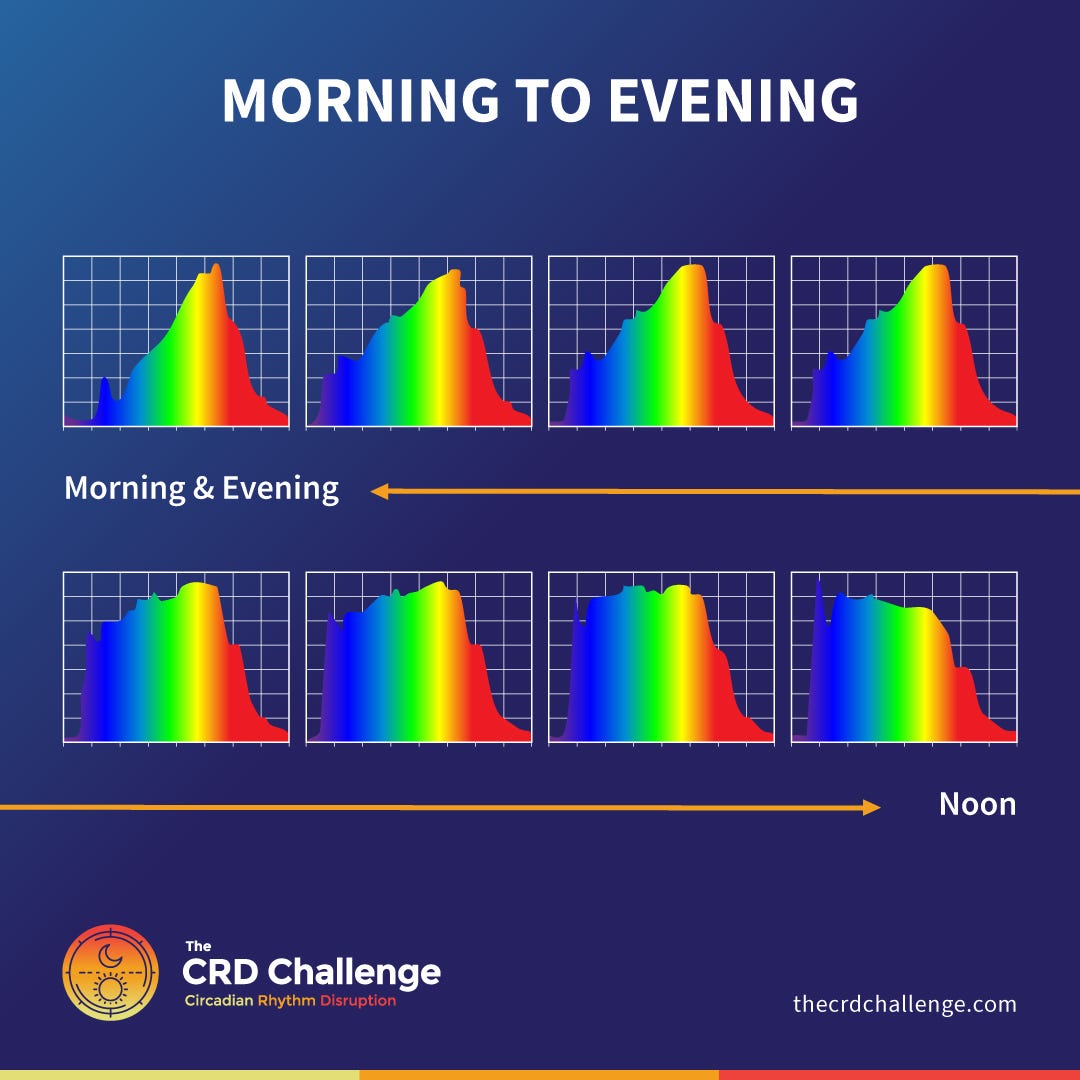
Following noon, the levels of blue light in sunlight fall over the course of the afternoon.
By sunset, all blue light wavelengths disappear from the atmosphere until dawn the next day.
But sadly, thanks to modern types of artificial lighting, nature is no longer the only source of blue light in our environment.
Modern bulbs have been enriched with blue because it makes them look “white” in colour to us.
These “white” light bulbs might make it easier to see, but they also bathe us in unnatural amounts of blue any time that the light is used, regardless of solar time.
Sending artificial blue light signals after sunset causes problems for our circadian health.
Using it also disrupts the circadian rhythms of plants, animals, and even microbes that share the planet with us.
The blue light from a standard electric bulb does not gradually rise and fall across the morning, afternoon and evening like the sun.
Instead, most lightbulbs emit an unchanging signal.
That means no matter if it’s day or night, these kinds of lights tell our SCN to give daytime signals and release the hormone cortisol.
Lux” - The “Intensity” Measurement of Light
Our bodies respond not only to colour but also to brightness.
The standard unit used for measuring a light source’s intensity is ‘lux’.
Lux is also referred to as illuminance.
Essentially, lux levels measure the amount of light illuminating a given space or coming from a particular source.
To better wrap our heads around this, we’re going to explore the differences between types of natural and artificial light environments.
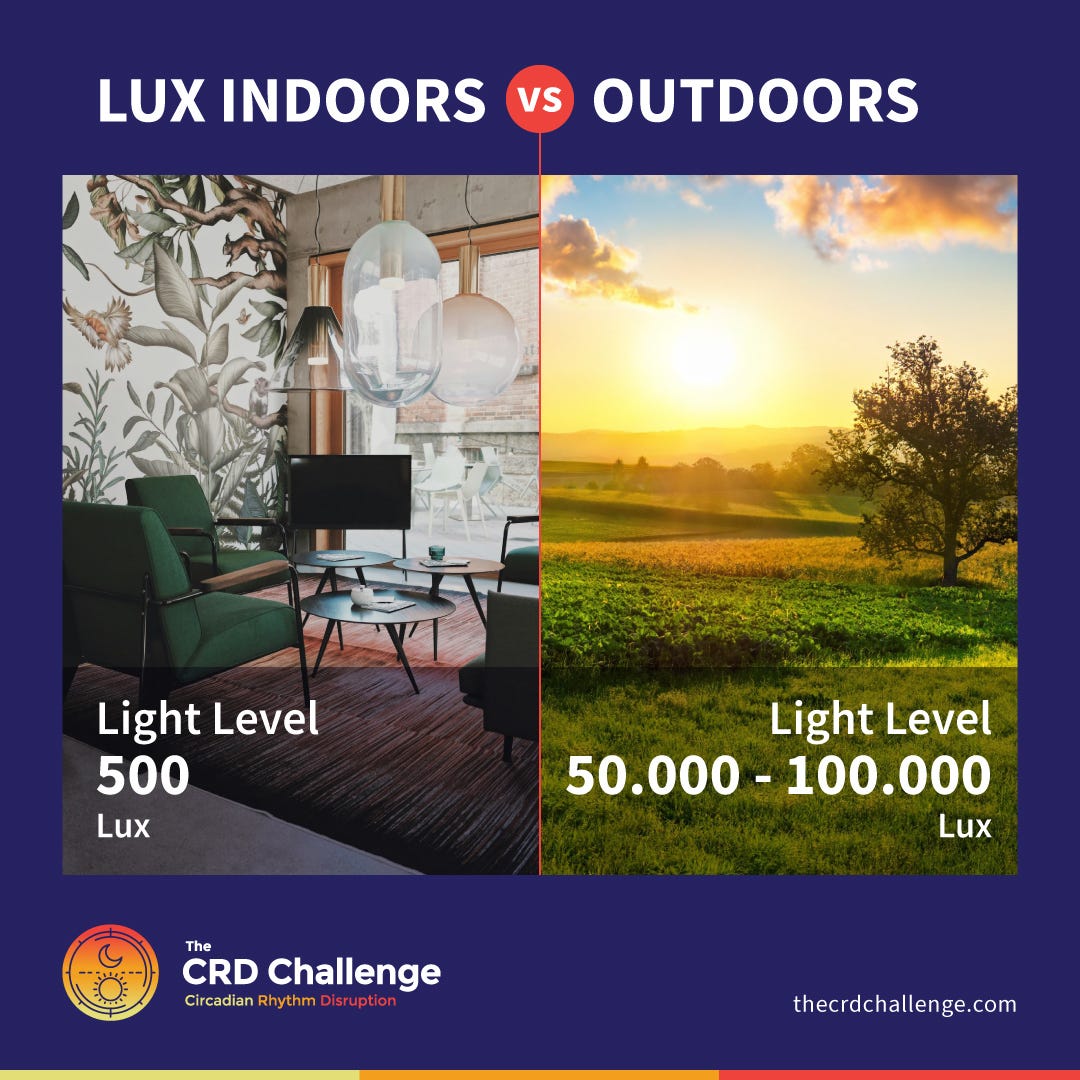
Our naturally lit outdoor environment yields the highest lux.
Although our eyes may perceive some forms of indoor lighting to be just as bright, indoor illuminance readings are always much lower than outside.
This is a really important point to grasp - that even if two types of light look a similar way, it doesn’t mean they share the same circadian properties.
Remember, melanopsin and the SCN are triggered by nonvisual cues present in light.
Even though the sky and a bright lightbulb may seem to give a similar amount of light, they don’t have the same colour wavelengths or illuminance.
This means that viewing outdoor and indoor light can result in wildly different impacts on your circadian rhythms.
Artificial bulbs in your home, school, office or other indoor spaces may seem very bright, but they often only measure between 200-500 lux.
Contrast this with a natural outdoor light, where even when the sky might look somewhat grey or dismal, it still measures somewhere 1,000 - 100,000 lux.
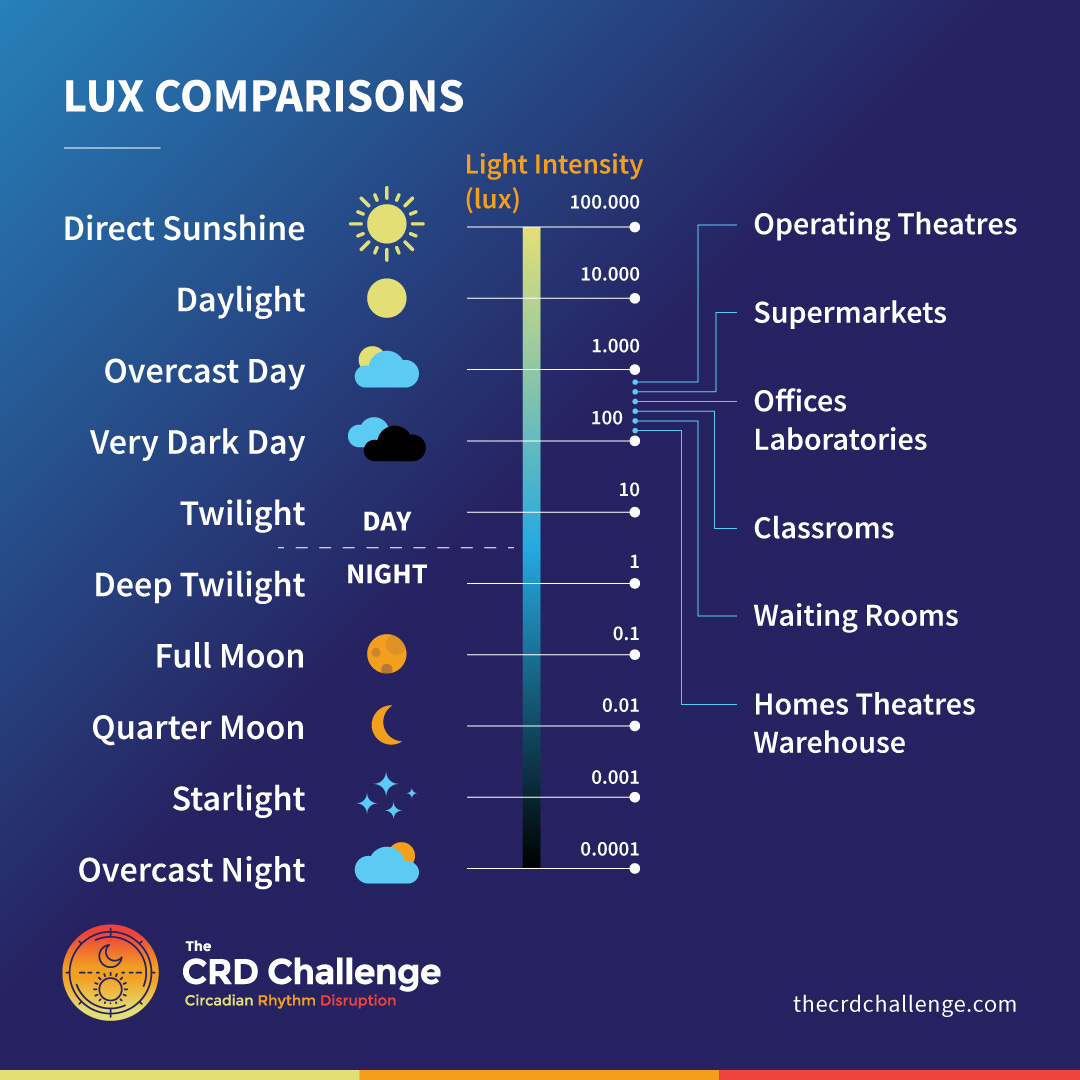
This difference is crucial to understand because your circadian biology interprets what time of day it is by measuring both the colour and intensity of light in its environment.
In the natural environment, light’s colour wavelengths and the illuminance intensity are always related to the time of day and outdoor temperature.
If it’s warm outside, bright, and blue, it’s daytime.
If it’s cooler, dimmer, and red or dark, it’s nighttime.
Your circadian biology relies on these daily fluctuations in light to control the timing of everything that happens within your body.
Here is a quick recap with a few more real-world examples to further drive this concept home:
In nature, by design, light’s characteristics change over the course of the day.
This gives powerful signals that all life forms perceive through their circadian physiology.
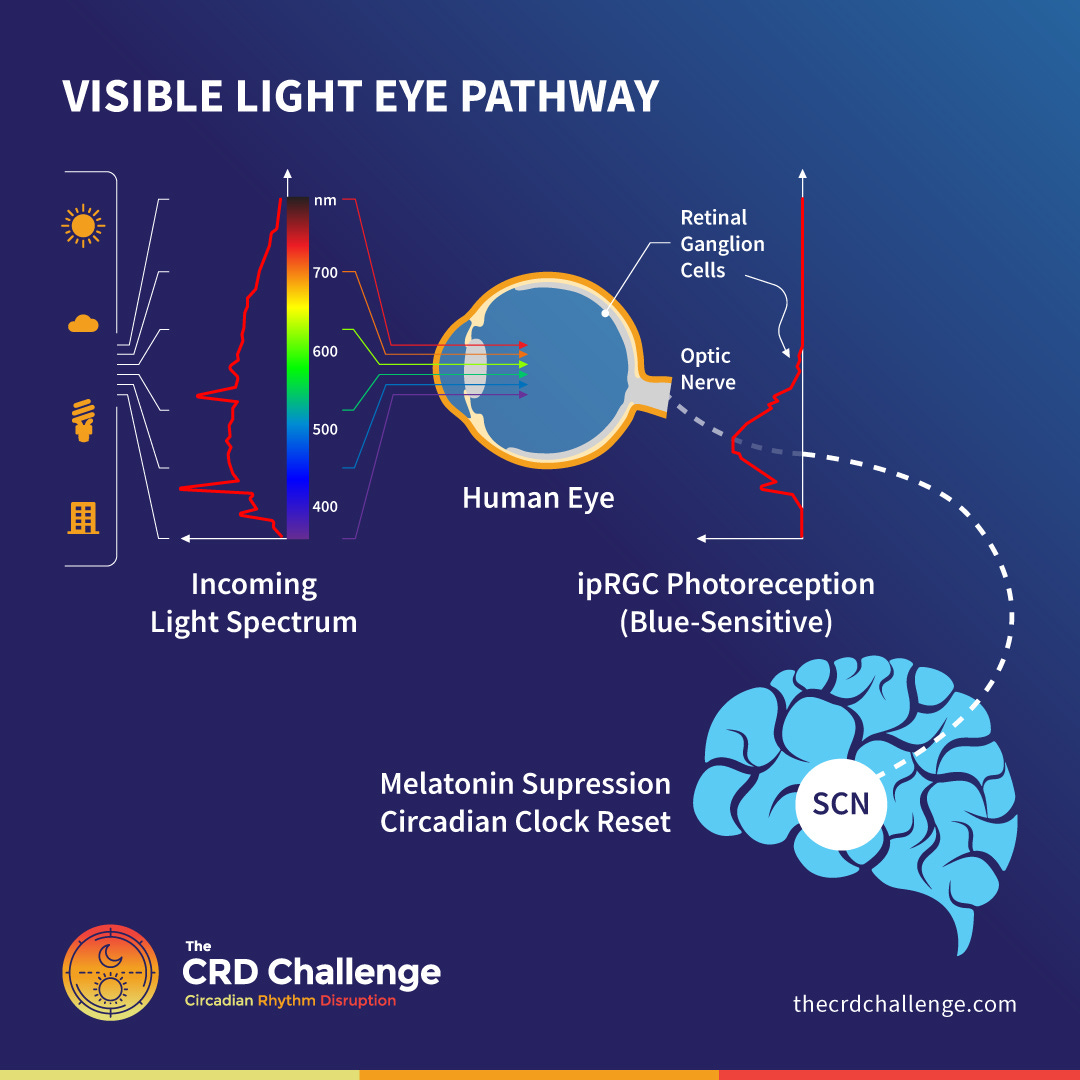
In humans, we gather those signals via melanopsin in our eyes and skin.
The gathered information is relayed through the SCN to the rest of our body.
The information sent by the SCN dictates the circadian processes in every cell, tissue, organ and system.
Think about where you are at right now.
Is it daytime and time for cortisol-regulated activities?
Or is it nighttime and time for melatonin-regulated activities?
Could your body know that based on the light signals it is picking up at this moment?
Exposure to a natural light environment will always give accurate cues.
In the early morning, the sunlight’s blue and bright feeling leads to an increase in cortisol production, waking you up so that you’re alert and ready to act.
In the evening, sunlight’s redder and dimmer feeling informs the circadian system that nighttime is approaching so that you’ll begin winding down and relaxing under the handoff of cortisol to melatonin.
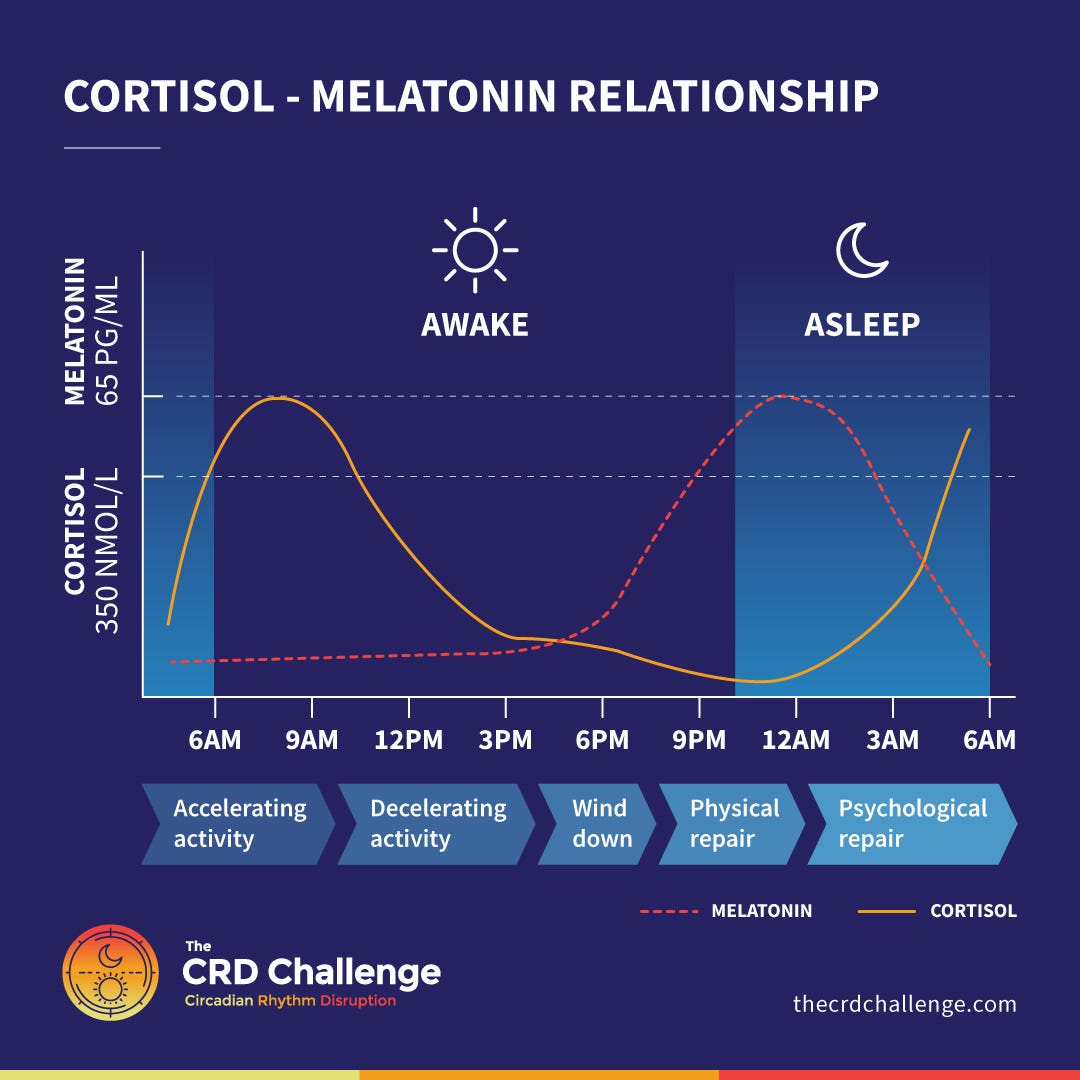
Melatonin will then support repair and rejuvenation programmes ahead of sleep.
This in turn will help you feel all the more rested when sunrise arrives again.
By now, you’re starting to see the circadian problem that comes with most artificial light.
The wavelengths and lux levels in our modern indoor light environments are out of sync with what’s happening outdoors.
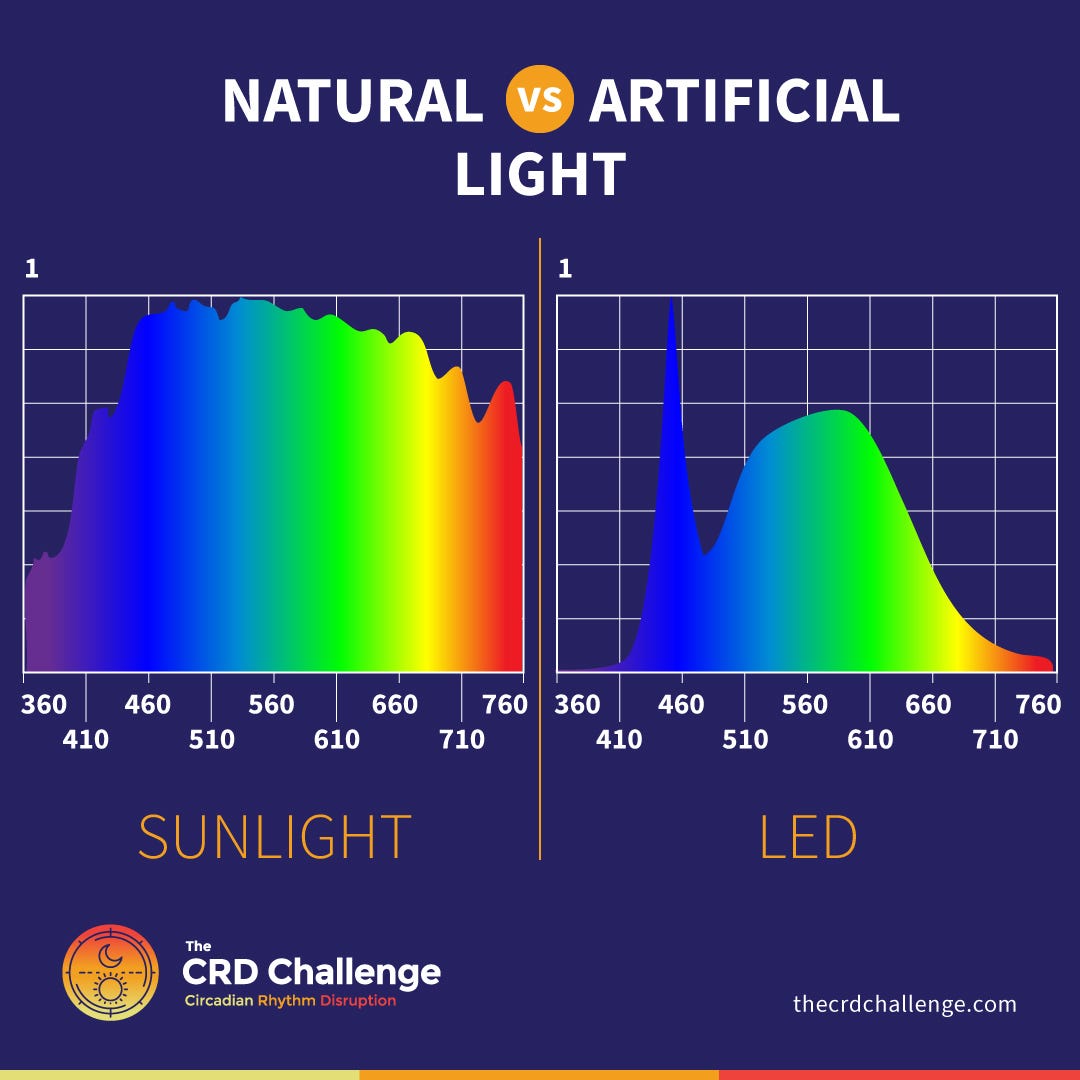
From a circadian perspective, that means they often give inaccurate time signals.
Artificial light does act as a zeitgeber or ‘time cue’, but it’s out of sync with nature!
It tricks our eyes to gather and transmit confused signals to our master clock in the SCN.
Think about how stimulating a hot, noisy, dancefloor with bright flashing lights feels.
Think about how tired you feel the next morning after staying out late in that type of environment.
And that is what your circadian rhythm experiences even in most “normal” modern homes lit with blue-enriched LED lightbulbs.
This has downstream effects on all of the cells, tissues, organs and systems that rely on those ancient light-timed circadian pathways.
Now that you know more about the different aspects of light, you’re beginning to understand the implications this has on how our body tells the time.
Let’s now dive straight into this week’s CRD Challenge practices.
You’re ready to take the first steps.
You’re ready to start stabilising and strengthening your circadian rhythms.
You’re ready to master your light.
Conveniently, there are only 2 times of day you need to focus on to start seeing huge transformations in how you feel.
We are sure you will be amazed at what happens when you begin harnessing the correct morning and evening light each day.
“We have finally learned that light is a nutrient much like food, and like food, the wrong kind can make us ill and the right kind can help keep us well.” - Dr. John Ott
Your ‘daily light diet’ is the light that enters your eyes and touches your skin from the moment you wake up until the moment you sleep.
The light you consume during sleep—hopefully very little—is also part of your light diet.
As the primary zeitgeber or time-cue, your light diet is crucial to your circadian health.
Mastering light is the most direct way to master the timing of your circadian rhythms.
That’s why this week’s practical challenge is for you to take the simplest steps needed to measurably improve your light environment.
You’re going to focus on the two most crucial times of the day - the morning and the evening.
Due to it being easier to wake up after a good night’s rest, we recommend you start by optimising your evening light behaviours.
With this, you lay the foundations of strong and stable circadian rhythms.
Resources