

Transcript:
A perfect circadian day starts with early morning light.
Viewing early morning sunlight is ideal for optimal circadian timing.
By early morning, we mean the sun’s light in the sky approximately at the time of sunrise and in the hours following.
Scientists have studied the impact that this type of light has as the gold standard for awakening, alerting and energising us by turning off our nocturnal production of melatonin and increasing early-day cortisol.
Nature’s perfect balance of morning light is the ideal information that our body expects to trigger our morning circadian processes.
Early morning sunlight emits a balanced colour spectrum with a rising intensity of between 1,000 - 100,000 lux.

Increasing levels of blue light communicate a ‘daytime’ signal to our eyes.
Our eyes then pass this information to the master clock in the SCN.
And from there, the signal is communicated throughout the whole body.
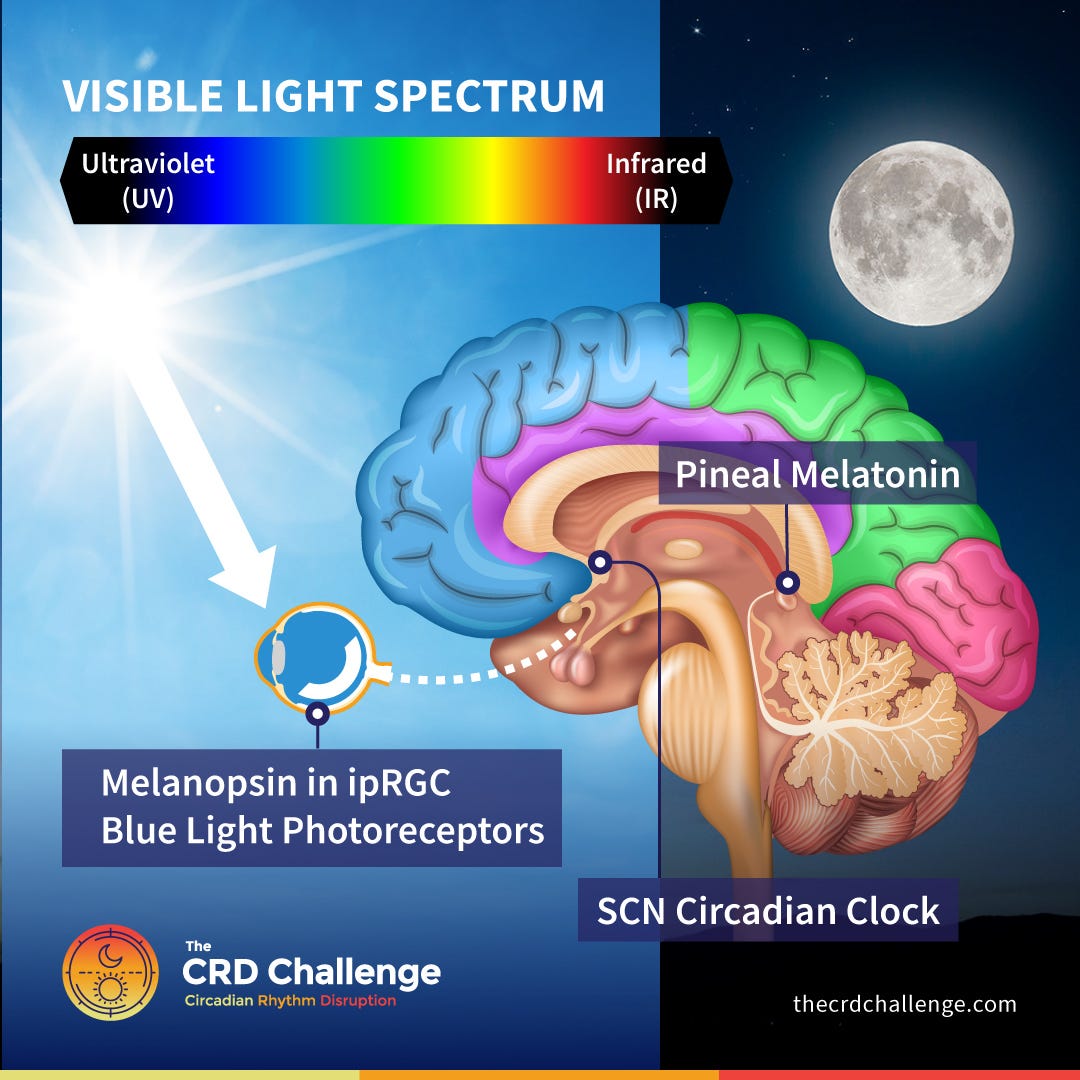
When you’re consistently gathering natural morning light you feel alert in your mind and body for the day ahead.
This is your body’s natural response to early morning sun.
Morning Light Practices
The CRD Challenge isn’t called a challenge for nothing!
No matter whether you like it or not, you need to get outdoors first thing every morning.
For the best circadian entrainment, you need to gather early morning sunlight.
This is the optimal type of light information to programme your body’s circadian rhythm for the day ahead.
As you begin to get a better night of sleep under no blue light, it should be easier than you expect to wake up for this.
This will be true even if you have identified as a night owl in the past.
Here’s the other aspect of the morning challenge: sunlight before screen light.
Most artificial screens from smartphones, computers, laptops and tablets have a lot of blue light.
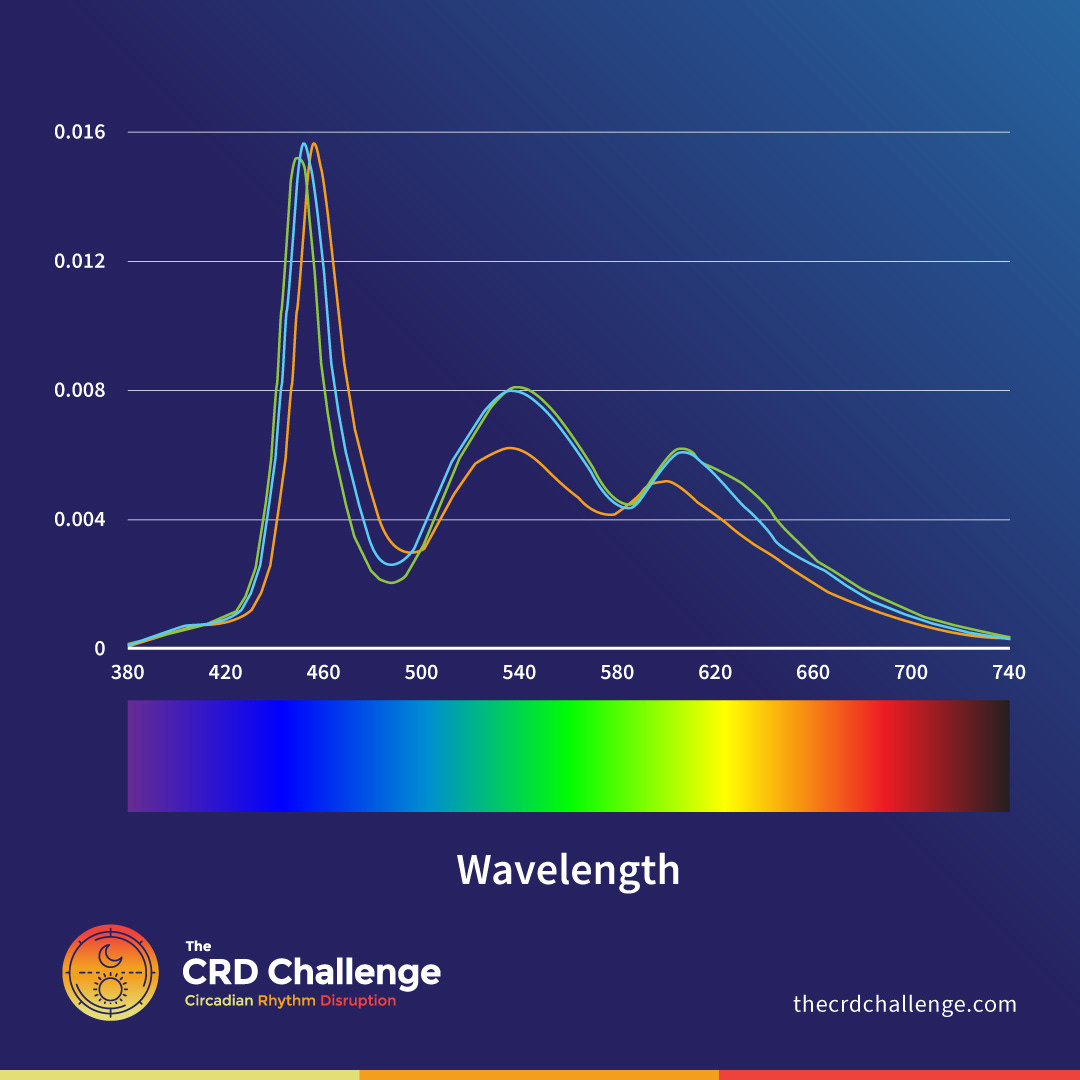
As we already explained, a lot of people don’t realise their bulbs and devices have blue light, because, to our eyes, it looks white.
But you can look at a spectral distribution to see the peak with a high volume of blue wavelengths.
To revisit the science, remember it’s the nonvisual system processing this information.
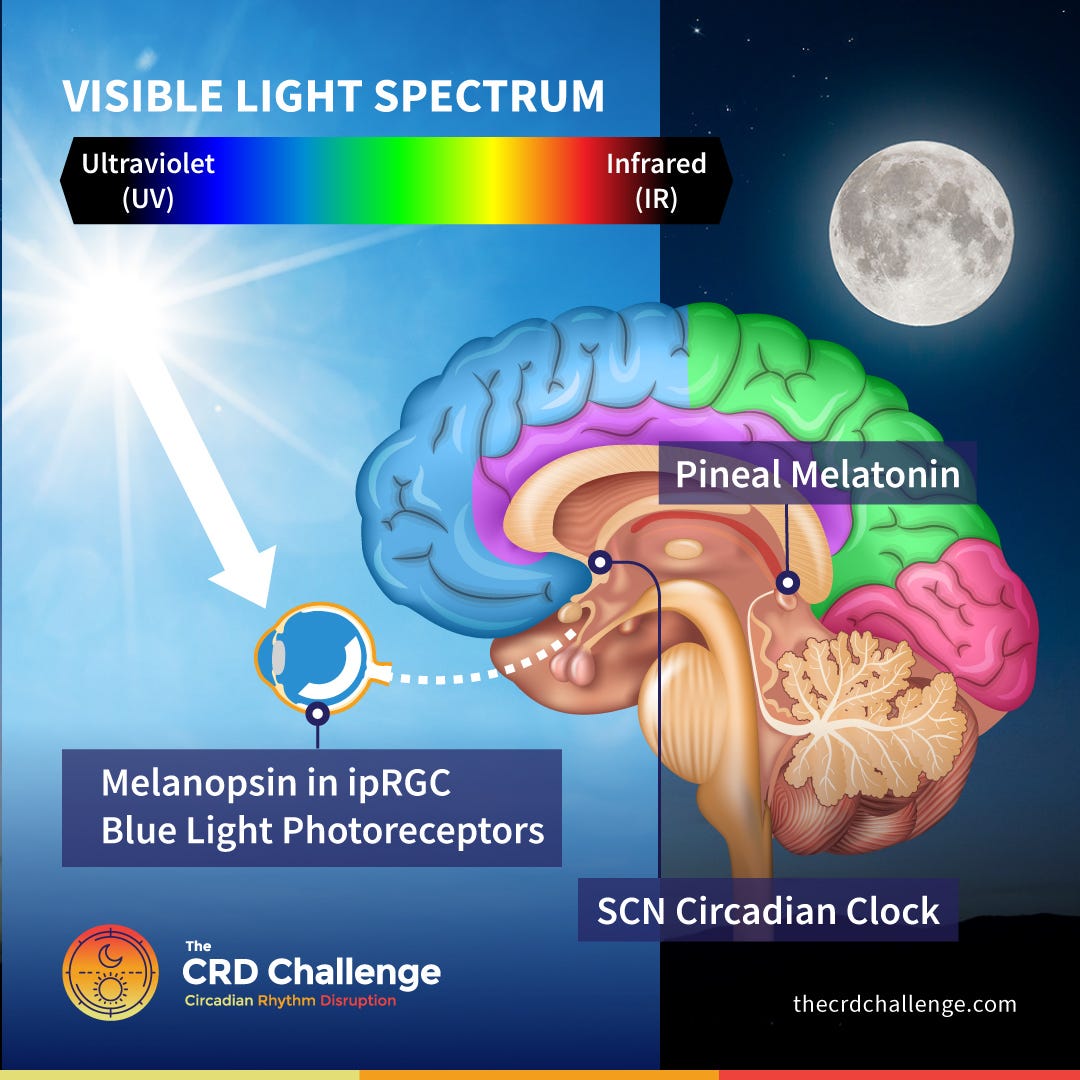
What you see with the visible part of your vision may not be the same as the information your circadian rhythm actually perceives.
Light from most screens is very unlike that contained in early morning sunlight.
Instead, at the nonvisual level, screen light is akin to the amount of blue light from sunlight at midday, only without the full spectrum balance of UV, warmer colours and Infrared.
This means that even though screens may be bright, your body cannot gather the benefits of early morning sunlight from them.
You’ll learn more about how artificial light sources are ‘incomplete’ to our physiology in Week 2.
For now, you’ll have to trust us on this.
Overexposure to artificial lighting and screens in the morning can confuse the circadian rhythm.
It can trigger an over-activated stress response where too much cortisol flows too early in the day.
If you absorb sunlight before screen light, you can avoid the mistimed light signal.
Instead of looking at your screens or artificial lights first thing in the morning, head straight outdoors and gather unfiltered natural light as close to sunrise as possible.
If you wake up before sunrise, great.
Keep the lighting indoors dim until it gets brighter outside and then get outdoors as the sun comes up.
If you wake up after the sun rises that’s fine too.
The goal is to get your eyes into natural light as soon as possible.
If the sky is completely clear, aim for at least 10 minutes outdoors.
If it’s partly cloudy or completely overcast, you should spend a little bit longer outside.
It may take 15 - 30 minutes to trigger the same benefits when the sunlight signal is less powerful.
If you can, view the natural morning light in its raw and unfiltered state, not through glass windows or sunglasses.
Even prescription glasses or contact lenses can filter out some of the wavelengths of light, meaning you won’t get as powerful a circadian cue if you’re wearing them.
It’s our bare eyes and skin that contain melanopsin which absorbs all the right signals.
This means it’s very beneficial to get at least a few moments of early morning light onto your face without anything covering it.
That doesn’t mean we’re advocating that you move around outside without your prescription glasses or contacts if that wouldn’t un-safe, but if you can find somewhere safe to sit, then uncovering your eyes for a few moments has lots of benefits.
If it’s impossible to get outside, open as many windows as possible to let as much unfiltered natural light indoors.
Each day that you focus on early morning sunlight exposure, you’re gathering the ideal light information.
You’re consuming the exact form of light your body needs to synchronise your circadian rhythms for optimal health.
Resources