

Transcript:
Welcome to Week 1 of The CRD Challenge
Today, we’re going to explore the most fundamental zeitgeber or time cue for your circadian rhythms in a whole new way.
This factor is light.
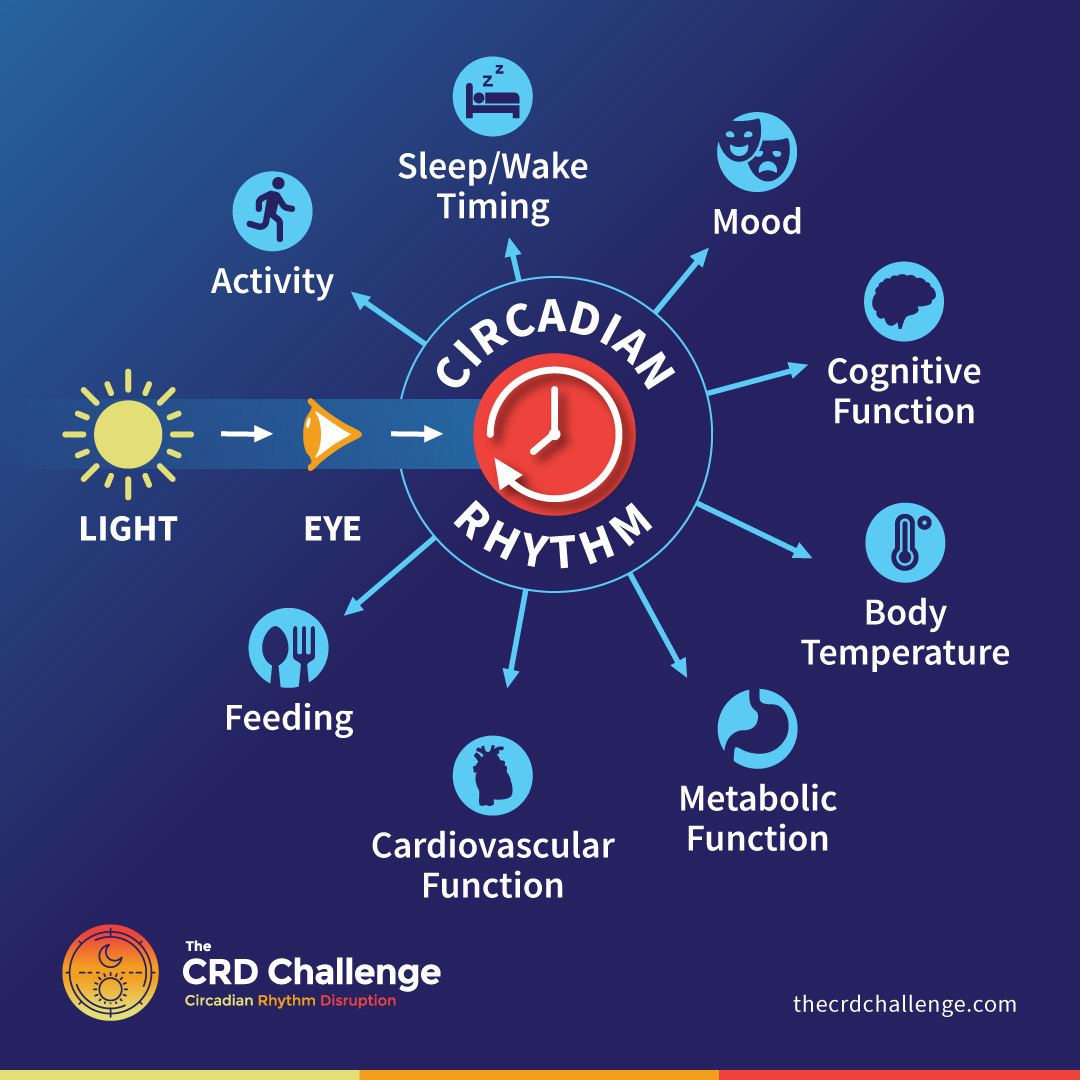
Light is the strongest thing influencing your circadian system.
The light you are exposed to, even at this very moment, is either setting you up for strength and stability, or total circadian disruption.
As you know, the circadian rhythm controls almost all aspects of your mental and physical health.
But what exactly is light, and how does it influence circadian rhythms.
If you search online for the definition of light, you’ll find many different answers.
You might hear that “light is a source of illumination, whether a natural one, like the sun, or an artificial one, like a lamp”.
You might also be told that “light is the opposite of dark” or that “light is what allows us to see”.
These definitions are useful in certain contexts but they don’t provide the depth of information you need right now.
For this challenge, you need to develop a fuller understanding of different types of light and how they each affect our biology.
This is because, over the course of each second, minute, hour, day, week, month, and year, the type of light you’re exposed to controls your circadian rhythms.
Light thus determines the journey of your entire life.
The CRD Challenge is all about improving your health by entraining your circadian rhythms to a natural pattern.
To achieve this you must be aware of the characteristics of both ‘visible and invisible light’ and how they can affect it.
Natural light sources include the sun, the moon and firelight.
Artificial sources include conventional modern lighting and technology screens.
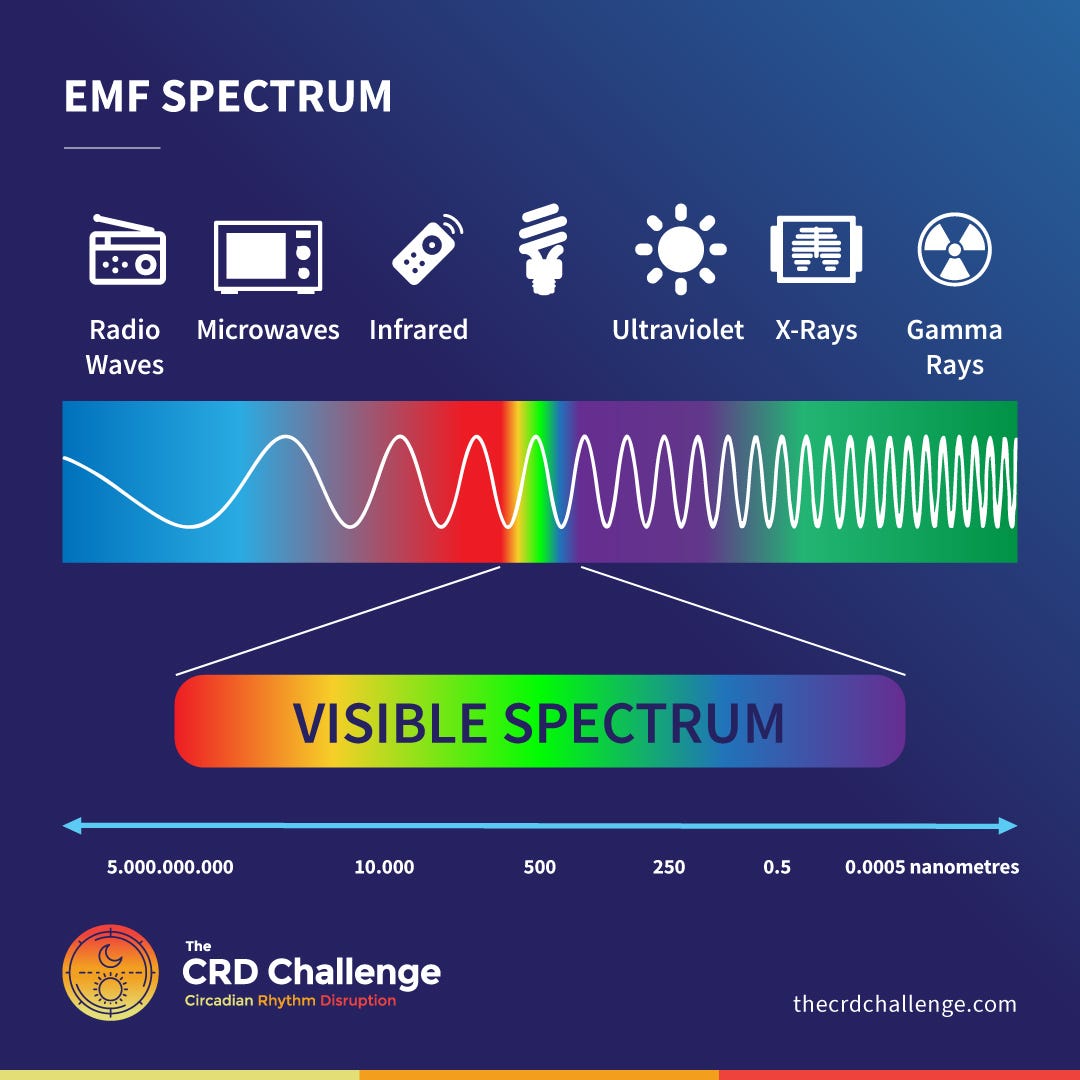
All these types of light that we’ve just mentioned form part of what is known as the ‘electromagnetic spectrum’.
This spectrum makes up the range of electromagnetic frequencies that have thus far been measured on our planet, ranging from gamma rays, to x-rays, to ultraviolet, visible, infrared, microwave and radio waves.
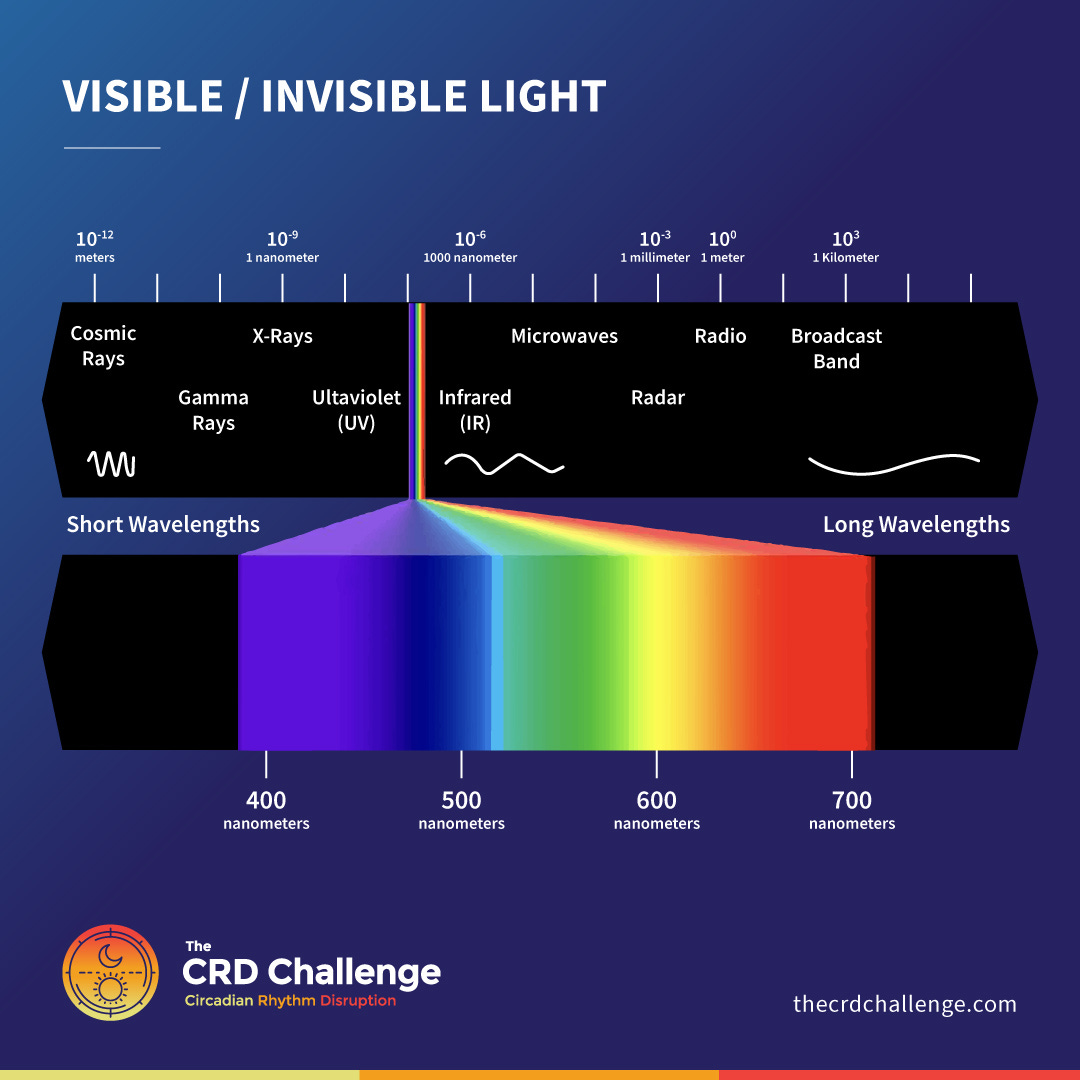
Today, we’ll be focusing our attention on how the UV, visible and infrared light frequencies influence us.
By now you know that light acts as the main time cue, or zeitgeber, for your circadian rhythms during the day and night.
Next, let’s take a look closer at how your body gathers and processes this light information.
Resources